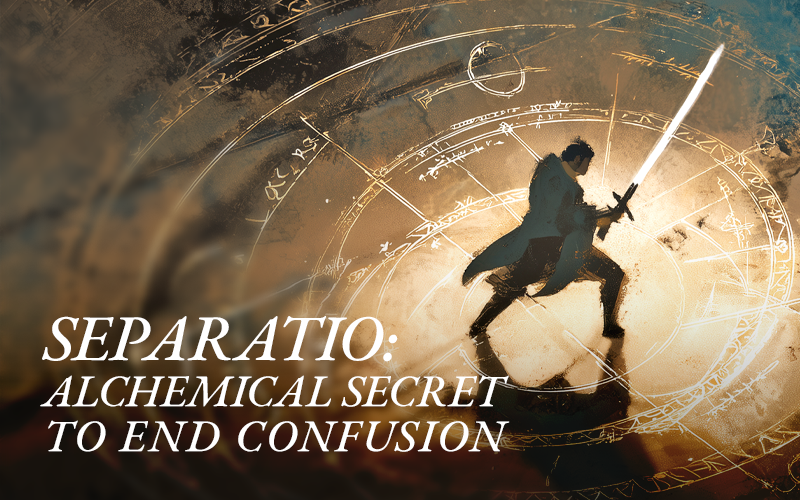
Before the separatio cut, we may live in a state of participation mystique, a fused state that blurs the distinction between me and not-me. Separatio begins when we tease the strands apart. We learn self-inquiry that helps us differentiate what happened out there from what stirred in here. This alchemical axiom can help us distinguish between the concrete facts and our idiosyncratic meaning. Many practical dilemmas hide behind this confusion. A person determined to file for divorce may need an inner parting, not a legal filing. Once we sort the outer action from the inner psychospiritual task, our next steps become obvious. With each clean distinction, room opens for choice. This happens when we recall our projection and feel our own anger, envy, or longing. We need to place our issues inside ourselves and stop hammering on other people to make us feel better. Like skilled surgery, the perfect psychological cut is in service to the healing process. The Ego stops hiding inside self-service interpretations and meets the object as an autonomous other. That clarification can bring grief, because projections carry love and hope. The mourning that follows marks the withdrawal of fantasy from its host. What remains is smaller and truer, thus enduring. In this way, separatio builds a durable relationship to people and to reality.
The Devil Archetype: A Jungian Analysis for Halloween
Oct 30, 2025
The devil archetype carries three qualities: it promotes bestial violence of every kind, it tries to convince us that the material world is the only reality, and it fools us into thinking we can spiritually ascend through intellect alone. On a personal level, it gathers our disowned infernal traits—envy, rage, greed, and the wish to dominate —and seduces us into believing those qualities are virtues. Once we face our own devilishness and grant it a symbolic form, we can assume a choiceful stance. Lacking that, we try to evacuate our own evil by projecting it onto others and then punishing them. As Jungians, we understand that our inferior function will first present as an imp. Still, with kind concern and thoughtful opportunities, it can transform into an uncanny ally that rescues us from malignant innocence. In its subtle form, the demonic attitude tempts us into literalism as it attacks our capacity to reflect and hold a symbolic attitude. Join us as we circumambulate The Devil in honor of Halloween.
SUBLIMATIO: Jung’s Alchemical Method of Turning Problems into Archetypes
Oct 16, 2025
translation into eternity of that which has been created in time. Jung’s 1944 visions are a model for the greater form, an elevation to an objective form in which one’s entire history is transformed into a single accomplishment. In the end, we come to realize our lived experiences will abide in the collective unconscious. Lesser ascents stabilize a new perspective; the greater places are in the universal. This distinction clarifies the range of ascent imagery in dreams and visions. It also calibrates therapeutic goals against eschatological experiences.
If Looks Could Kill: Surviving the Death Mother
Oct 2, 2025
Some mothers attack life in their children. They crush appetite, joy, curiosity, and initiative. They call it love or duty. It is not love. It is domination dressed as care. She withholds warmth to make the child obedient. She intrudes when the child needs space and vanishes when the child needs help. She shames tears, punishes play, mocks ambition, and polices the body. She turns boundaries into punishments and favors into chains. The Death Mother archetype is ancient and modern, requiring careful confrontation to free the parent and the child from its destructive grip.
MYTHS: Maps of the Collective Unconscious
Sep 18, 2025
Think of myths as the dreams of an entire culture. Those stories reside in the collective unconscious and influence all of us throughout our lifespan. Mythic patterns shape our attitudes, and when we recognize them, we can link our personal experiences to the universal. When you’re panicking, you’re under the influence of Pan; when you’re sunk in gloom, you’re on a night-sea journey like Odysseus. Jungians’ call linking the personal to the universal, amplification: take a symptom, link it to a myth, and you’ve shifted it from “my private defect” to “a shared force,” which gives us objectivity. Jung noticed that when we lose awareness of the mythic, those patterns secretly affect us and tend to act themselves out, sometimes recklessly. Today, we’ll help you bring these grand narratives into awareness and understand how they help and, at times, hinder you.
SOLUTIO: The Alchemy of Letting Go
Aug 14, 2025
Solutio is Psyche’s method to facilitate transformation: our rigid ego is softened in symbolic water, allowing outworn attitudes to unbind. We can see this reflected in dreams of oceans and baths, or a wall of our house dissolving. This can show up when we slough off our work persona or a creative depression brought on by retirement. Analysis itself—ana-lysis—a deliberate loosening, can deepen the process by offering a safe container to let go and yield to the process. The work is careful because the waters that purify (baptism or tears) can also drown us (psychosis or crowd contagion). We require a supportive relationship, a daily spiritual practice, or the analytic hour to hold us as our ego reorganizes like a butterfly in a chrysalis. Once our ego solidifies, we notice we’re more permeable to symbols or less defended against feelings. We’re more skilled at breaking problems into their component parts with a determination to resist regressing. The alchemical process was not created; it was noticed as a natural pattern of transformation. It leaves us with more of who we really are, but we couldn’t have claimed until we became soft enough to receive it.
CALCINATIO and the Alchemy of Honest Suffering
Jul 18, 2025
The calcinatio stage in Jung’s alchemy is about being put through inner fire—it’s when the ego undergoes a kind of burning away of projections, illusions, and inflated ideas about itself. This stage often brings intense suffering, frustration, and confrontation with parts of yourself you’d rather avoid. It’s about staying awake in the heat long enough to discover the truths behind your defenses. Sometimes it’s like sitting in hell and roasting. This raw, honest suffering is necessary for individuation. It’s not punishment—it’s Psyche’s way of depotentiating false structures so that something new and more truthful can emerge from the ashes.
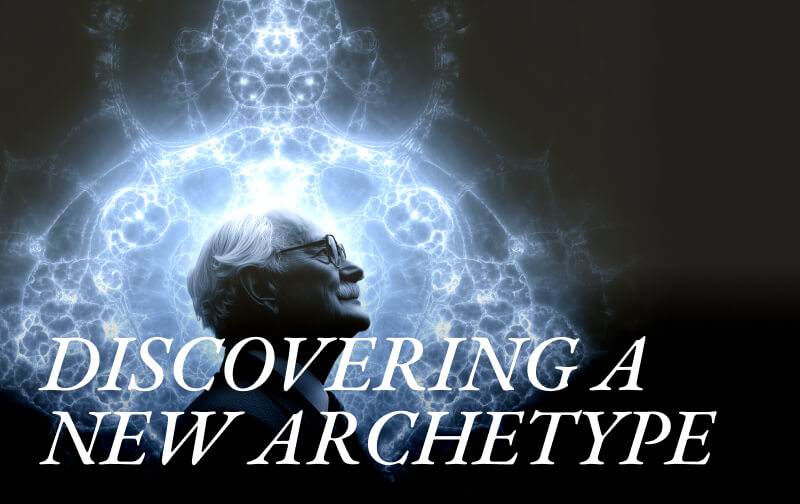
DISCOVERING A NEW ARCHETYPE: the Buddhabrot Fractal Bridging Math, Myth, and the Collective Unconscious
Jul 10, 2025
The Buddhabrot pattern springs from a simple algorithm: you take thousands of starting points, run each one through the same formula over and over, and chart only those whose values grow without limit—these “divergent” paths form the spectral Buddha-like silhouette. Once you recognize the pattern, you see it everywhere. It’s visible in the rosette stained glass windows of Notre-Dame de Paris and Chartres, numerous representations of the buddha, as well as in the Vāstu-Puruṣa-Maṇḍala used as blueprints for Indian temples, and in the ancient chakra symbols that are now so common—proof that numbers are universal symbols tying Psyche to the world. This is a newly identified archetype: an algorithmic icon born of computation that reveals an underlying cosmic unity that C.G. Jung called the Unus Mundus. Dr. Harry J. Shirley joins us and provides an amazing initiation into this uncanny discovery.
SHARK: Elemental Symbol of our Will to Survive and Ravenous Hunger For Experience
Jun 19, 2025
From depths ancient and obscure, the shark emerges, slicing effortlessly through the primal waters of Psyche. It is ancient, older than trees, a remnant from eons before humans carried consciousness. With sleek lines and unwavering purpose, it embodies life’s earliest impulse: to hunt, to feed, to survive. No morality softens its edges; no sentiment clouds its gaze. In encountering the shark, you encounter life stripped bare: existence distilled into a single, relentless will to continue, no matter the cost.
Sibling Rivalry: Archetypal Conflicts and Shadow Dynamics in Families
Jun 5, 2025
Sibling rivalry can bruise and build in equal measure. On the hard side, the older child feels toppled from the throne, the younger scrambles for a foothold, and both learn how quickly envy, resentment, and score-keeping ignite—whether over a parent’s extra hour of attention or the larger slice of birthday cake. Those early contests can calcify into adult grudges that surface in estate negotiations, workplace jockeying, or mismatched relationships. Yet the same daily friction teaches useful skills: we sharpen empathy by reading a sibling’s next move, develop a theory of mind through constant negotiation, and discover that competition does not rule out loyalty—especially when a crisis calls every rival home. Listen and discover how sibling rivalry is both the first training ground for conflict and the first workshop for cooperation, shaping how we handle fairness, attachment, and resilience for the rest of our lives.
Mandala Archetype: How the Self Turns Chaos Into Cosmos
May 29, 2025
Mandalas are Psyche’s way of drawing a compass for you when life feels off-kilter. Jung noticed that these circular patterns—whether they appear in Navajo sand paintings, Tibetan yantras, or last night’s dream—pull everything back toward a stable center he called the Self. The rim defines where your ego ends; the cross-lines and repeating fours help you locate sensation, feeling, thinking, and intuition in relation to your core. By “walking” the circle, even in imagination, the ego learns to orbit rather than hijack the organizing center, and the usual tug-of-war between instinct and spirit eases. Jung’s own Liverpool dream, with its sunlit circular island in a dark industrial square, showed him how a mandala can emerge autonomously whenever Psyche needs to order chaos and point the way back to wholeness. Curious why a circle keeps popping up in dreams and sacred art?—tune in and find out how it can quietly realign your life.
Detective Archetype Decoded: Tracking Symbolic Clues
Apr 6, 2025
The detective archetype speaks to a universal drive for uncovering what has been concealed. This impulse emerges whenever communities sense the weight of secrets, crimes, or enigmas that destabilize ordinary life. By taking on the role of investigator, the detective strives to reestablish clarity and order, reflecting humanity’s innate desire for comprehension. Yet the archetypal detective does more than solve puzzles; he or she addresses the fundamental mystery of how darkness and truth coexist.